
Lesson context
Why this matters
“Jeweller” can mean a shop, a maker, a designer, or a specialist, and many businesses mix these roles. Understanding the role helps you choose the right service for a custom ring and ask better questions.
Your learning plan
Learning goals
By the end of this lesson, you’ll be able to:
- Identify the six main types of jewellery business or role in the UK
- Explain the difference between a retail jeweller and a bench jeweller
- Understand what "trade" work means in a jewellery workshop context
- Describe what a hybrid jeweller does and why this is common in custom ring making
- Recognise that many jewellers combine more than one of these roles
The word "jeweller" can mean very different things. Dictionary definitions include both "a shop" and "a person who makes, repairs or sells jewellery" (1). In practice, one business can mix several of these roles at once, while another might cover only one.
1. Retail jewellers
Retail jewellers on the high street typically sell stock lines: ready-made designs ordered in volume from manufacturers, often through wholesale supply. "Wholesale" means buying goods in large quantities at lower unit prices for resale. Because large chains buy at scale, they can benefit from economies of scale and sometimes offer competitive prices on standard lines (2). For example, H.Samuel operates over 300 UK stores and is part of Signet Jewelers, described as the world's largest jewellery retailer (3). [Brand data supplied by client.] The main limitation for a custom ring buyer is that retail chains primarily sell from fixed catalogues, with little or no scope for a fully original design.
2. Local independent jewellers
Many local independent shops also stock wholesale-made pieces alongside their own ranges, but smaller buying volumes can mean fewer bulk discounts than major chains, which is sometimes reflected in prices on comparable lines (2). Where independents often have a real advantage is in flexibility: many run their own workshops and can produce custom rings alongside their retail offer, though having both a shop and a workshop can add to overheads and is reflected in pricing.
3. Goldsmiths and bench jewellers
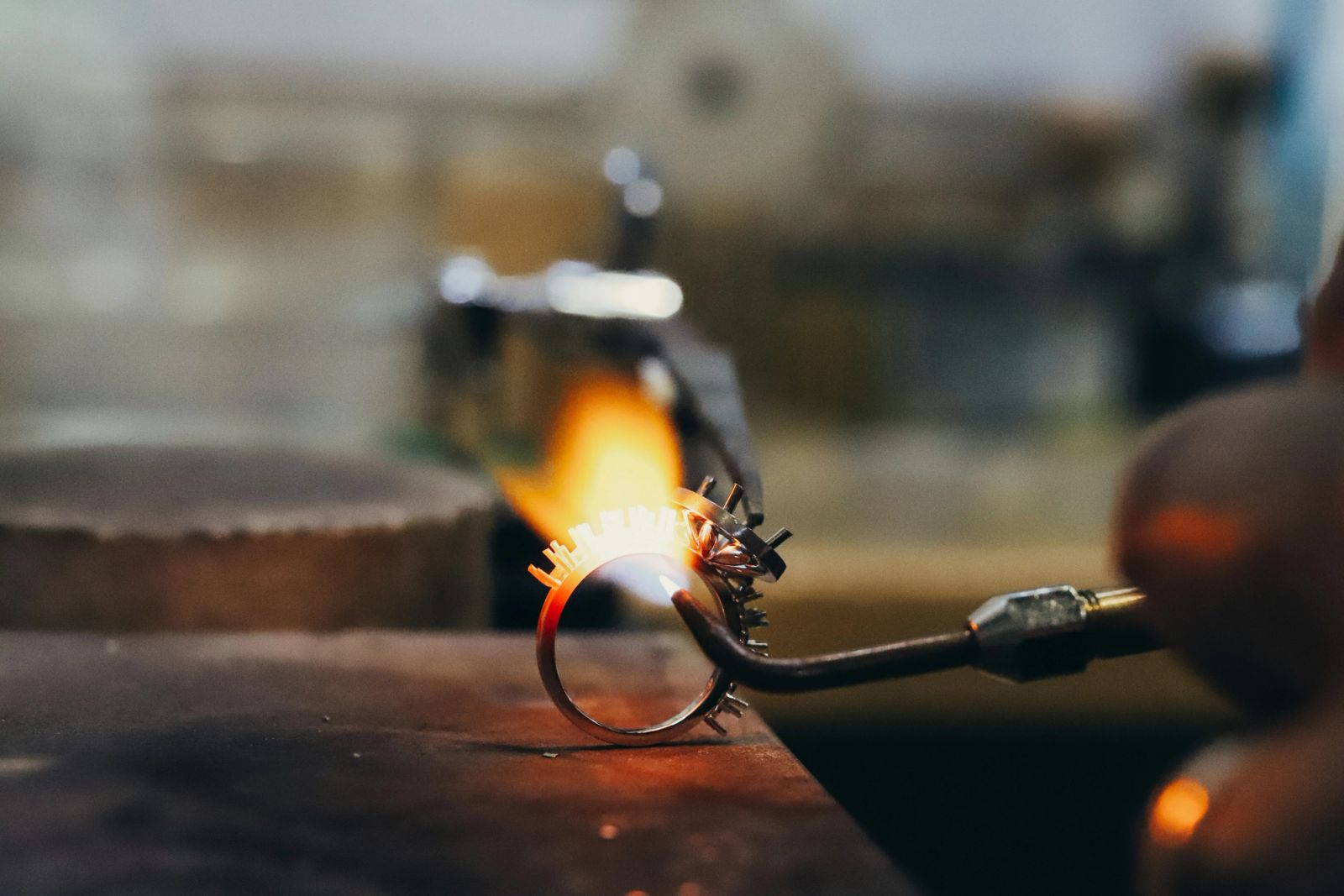
A goldsmith is "a person who makes or repairs things made of gold" (4). In practice, goldsmiths and bench jewellers are the people physically making rings at the workbench – shaping metal, assembling components, and finishing pieces by hand (5). Many workshop makers do "trade" work: making or finishing pieces on behalf of other jewellers or brands, invisibly in the background, while also taking private commissions directly from customers (6). If a retailer does not have its own workshop, it may be sending your ring to a trade goldsmith you never meet.
4. Designers
A designer's role is to translate a customer's inspiration into a clear, workable plan – using sketches, technical drawings, and computer-aided design (CAD) renders that a maker can build from (7). Some designers also make their own pieces; others hand a finished brief to a workshop. When you commission a custom ring, you may be working with a designer and a maker who are different people, or the same person doing both.
5. Specialists
Several high-skill roles exist within the making process that are sometimes carried out by dedicated specialists rather than one person doing everything. A diamond mounter makes the metal framework, called the mount, into which stones will be placed (8). A setter then secures the gemstones into that framework using specific setting techniques (9). A valuer produces formal written valuation documents for insurance or resale purposes (10). In smaller workshops, one person may cover several of these roles; in larger operations, each step may be passed to a different specialist.
6. Hybrid jewellers
In practice, the type of jeweller most relevant to a custom engagement ring commission is what might be called a hybrid: a business that combines design, stone sourcing, specialist coordination, and finishing – acting as a single point of contact for the whole project. This is the model followed by many independent custom jewellers.
Boutee's network is a curated group of independent jewellers for engagement ring commissions, and most jewellers on the Boutee platform sit in this hybrid space.