
Lesson context
Why this matters
Not every engagement ring starts with a new stone bought from a jeweller. Many people inherit a family diamond or gemstone, own a ring they no longer wear, or simply want to give a sentimental stone a new life. A custom jeweller can take that stone and set it into an entirely new design, creating something personal and meaningful without the cost of a new gem. Understanding how the process works – and what the potential complications are – helps you approach it with realistic expectations.
Your learning plan
Learning goals
By the end of this lesson, you’ll be able to:
- Explain what it means to "reset" an existing stone
- Understand why a professional stone inspection is essential before resetting
- Describe what a jeweller checks for during that inspection
- Recognise the main design options available when resetting a stone
- Know the key practical considerations, including paperwork, cost, and what happens to the original metal
What does resetting mean?
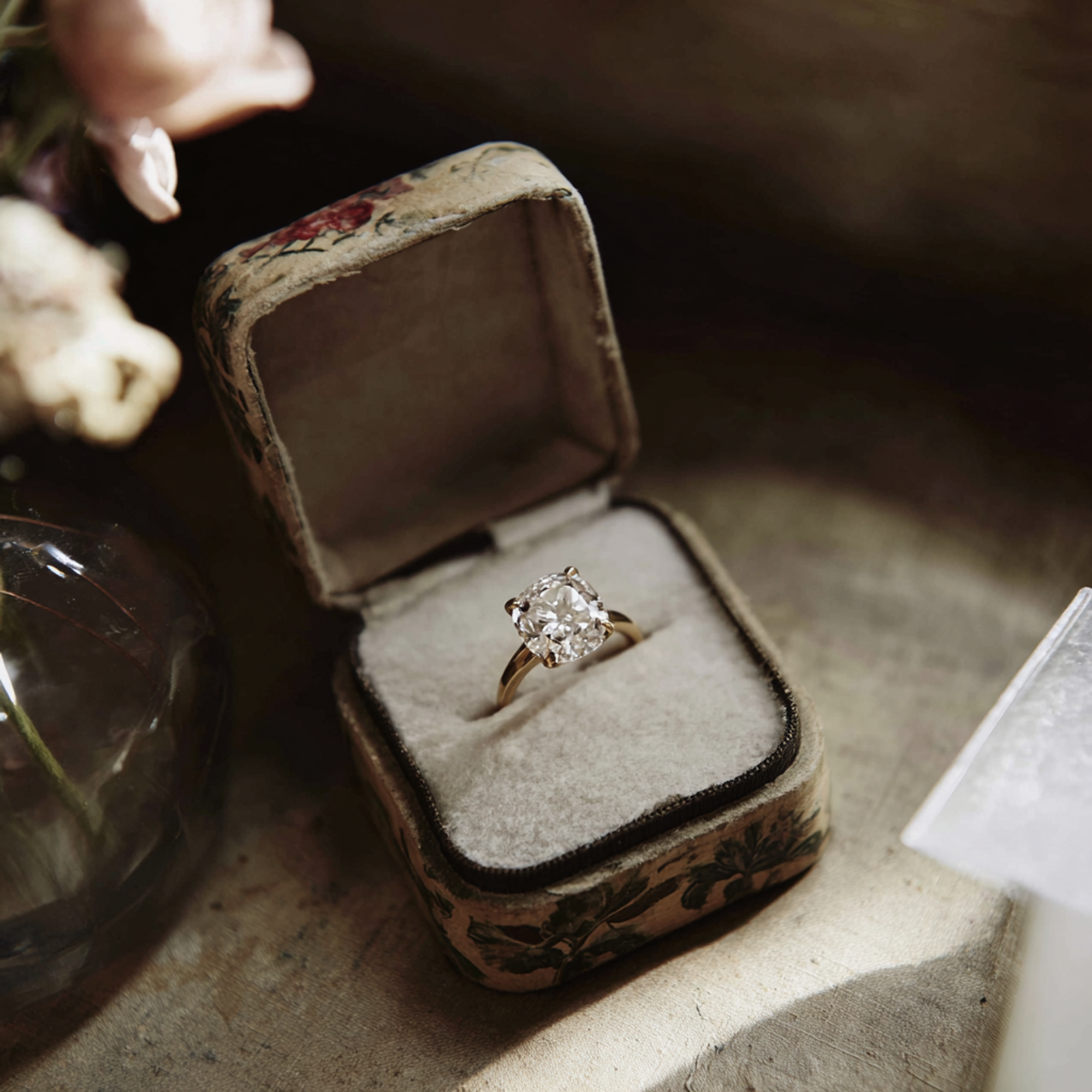
Resetting means removing a stone from its existing setting and placing it into a new one (1). The stone stays the same; what changes is the metal framework holding it. This is one of the most personal routes into a custom ring, particularly when the stone has been passed down through a family or carries strong sentimental value. It is also considered one of the more environmentally responsible choices, since no new mining is required to source the gem (2).
The inspection: the most important first step
Before any design work begins, a reputable jeweller will inspect the stone carefully (3). This step is not optional – it directly determines whether the stone can be safely reset and what design constraints apply.
During inspection, a jeweller typically assesses (3, 4):
- Overall condition – checking for chips, cracks, or surface abrasions that might affect the stone's appearance or structural integrity
- The girdle – the narrow edge around the widest point of the stone, which is particularly vulnerable to chipping during the removal process
- Existing inclusions – noting whether any internal marks are close to the surface and therefore at risk during handling
- Shape and dimensions – measuring the stone precisely, since the new setting must be built to fit it exactly
It is worth knowing that some older stones do carry hidden damage that is only visible under magnification, and occasionally the act of removing a stone from a very old or tight setting can itself cause a chip, particularly if the girdle is thin (3). A good jeweller will tell you this honestly before proceeding.
Grading reports and paperwork
If the stone has an existing grading report from a recognised laboratory such as the GIA, bring it to the consultation. It confirms what you have and makes the design conversation more straightforward. If no report exists, and the stone is over half a carat, it is worth considering having it independently assessed before resetting, so that both you and the jeweller are working from an accurate baseline (4).
Design options
Once the stone has been assessed and confirmed as suitable, the design process is the same as for any other custom ring. The stone's shape and dimensions become the starting point: the setting, band profile, and metal are all chosen around it (5). Popular approaches include placing a sentimental diamond into a modern solitaire design, combining stones from different family members into a three-stone ring, or adding a halo of new accent stones around an older centre stone to increase its visual impact (1).
What happens to the original metal?
If the stone comes in a setting, you will need to decide what to do with the original metal. In some cases, particularly where the original piece is also emotionally significant, the old metal can be melted down and used in the new ring (6). However, this is not always straightforward: some older alloys, particularly 9ct gold or mixed alloys, may not blend cleanly with new metal. A jeweller will advise whether reuse is practical or whether it would be more reliable to trade the metal in as scrap and use its value as credit towards the new design (6).
Cost and timing
Using an existing stone generally reduces the overall cost of a custom ring compared with sourcing a new one of equivalent quality, since the gem itself is already paid for. However, the custom setting work, CAD design, and craftsmanship still carry their own costs, and complex designs or additional stones will add to these (7). Most resetting projects take between four and six weeks from consultation to completion, depending on design complexity (1).
Lesson glossary
Key terms
- Resetting
- Removing a stone from its existing setting and placing it into a newly made one
- Heirloom stone
- A gemstone inherited or passed down through a family, often with personal or sentimental significance
- Girdle
- The narrow edge around the widest point of a cut gemstone, which can be vulnerable to chipping during removal from a setting
- Grading report
- A document from an independent laboratory confirming a stone's quality characteristics
- Inspection
- A professional assessment of a stone's condition, dimensions, and suitability for resetting, carried out before design work begins
- CAD
- Computer-aided design; the digital 3D modelling process used to build and visualise a new ring design before manufacture