
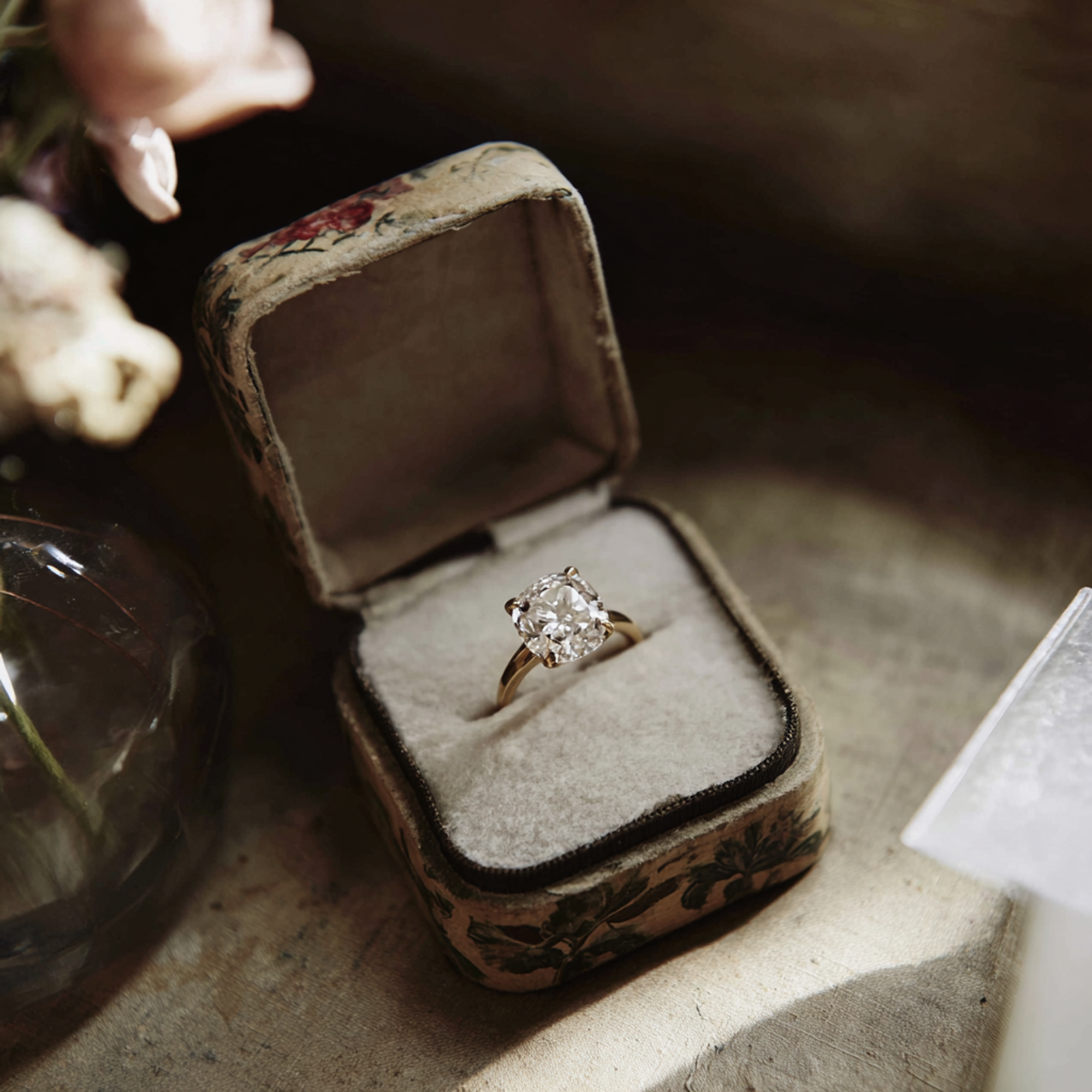
This lesson explains the main ways a custom ring is made, and why quality depends on good engineering, careful bench work and secure stone setting
Why this matters
A custom ring is not made in one single step. GIA treats fabrication, metalworking, stone setting and quality control as separate bench skills, and it also teaches that CAD designs must be created to engineering specifications and with real manufacturing limits in mind.[1,2]
That matters because buyers often hear broad phrases such as “handmade” or “cast” without knowing what they actually mean. In practice, the method affects how the ring is built, but the final quality still depends on workmanship, finishing and how well the stone is set.[1,2,5,6]
Learning goals
- Know the difference between casting and hand-making
- Understand what stone setting adds to the process
- Recognise why finishing and quality checks matter
- Identify simple signs of good workmanship in a finished ring
Key ideas
Casting: building the ring from a model
Casting usually starts with a wax or resin model rather than with the final metal itself. GIA describes the traditional lost-wax process as burning the wax away from a mould, then pouring molten precious metal into the empty space. Its education catalogue also describes modern production steps such as printing resin and wax models, then spruing, treeing, investing, burnout and casting.[3,4]
Casting is useful because it can turn a detailed model into a metal ring efficiently. It is common in custom work as well as wider production, especially when the design begins in CAD and then moves into physical manufacture.[2,4]
Hand-making: shaping the metal directly
Hand-making, often called fabrication, means building the ring directly from metal using bench skills such as sawing, soldering, forming, forging and finishing. GIA’s Graduate Jeweler programme teaches exactly these kinds of tasks, including forming ring blanks, milling wire, forging rings and assembling components by hand.[1]
This route can suit designs that need direct bench control or later adjustments during making. It also helps explain why two custom rings with a similar look may involve very different amounts of labour.[1]
Stone setting: where security becomes critical
Stone setting is a separate skill, not just the final decorative step. GIA teaches multiple setting styles, including bezel, V-prong and bar-channel settings, and its quality benchmarks show how exact good setting work needs to be.[1,5]
For a well-set round stone in prongs, GIA says the stone should be level, with no gaps between the stone and the bearing, the prongs should be evenly rounded and consistent in shape, and the tops of the prongs should be in full contact with the stone’s crown.[5]
Good quality is visible at the end
A well-made ring should also be finished properly. GIA’s platinum finishing benchmark says the piece should have a bright lustre, no fine scratches visible to the unaided eye, and no tool marks left from earlier work. It also explains that poor prefinishing makes it impossible to achieve the best final polish later.[6]
GIA also warns that poor setting work can lead to real problems in wear. Overcut bearings, weak support or badly positioned prongs can allow a stone to loosen or become dislodged, and loose gemstones can damage both the gem and the setting if the problem is not caught early.[5,7]
Key terms
- Casting — making a metal ring from a wax or resin model through a mould
- Fabrication — building a ring directly from metal by hand
- Stone setting — securing a gemstone into the ring
- Bearing — the cut seat inside the setting where the stone rests
- Prong — a small metal claw that holds a stone in place
- Prefinishing — early smoothing work done before the final polish