
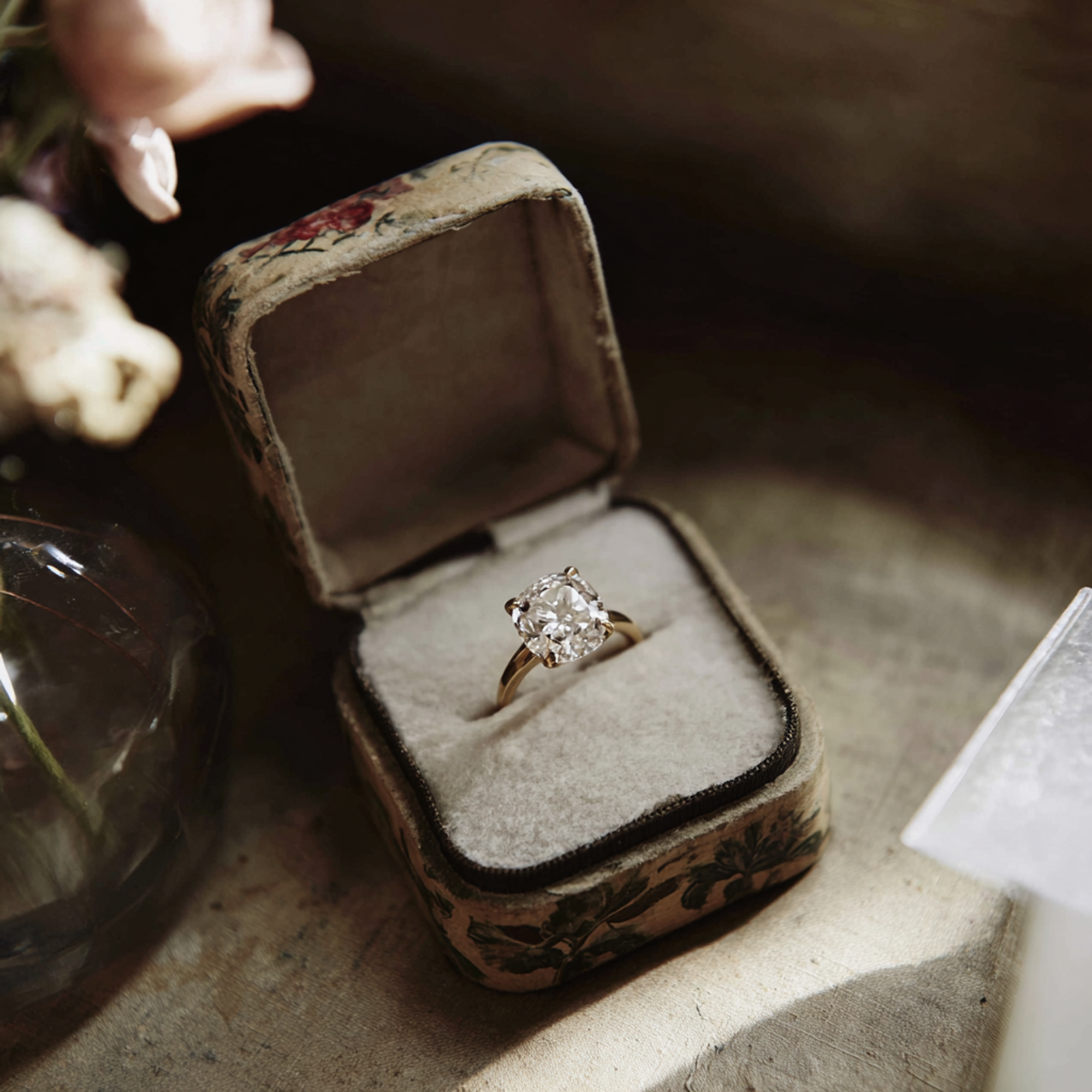
This lesson explains the main quality checks to make when you collect a custom ring, so you can confirm it is well finished, secure and correctly documented
Why this matters
Collection is the best moment to catch problems while the ring, the paperwork and the jeweller are all in front of you. GIA’s published workmanship benchmarks for finished platinum rings say a properly finished ring should show no fine scratches visible to the unaided eye, be free of tool marks, debris, pitting and porosity, and have readable hallmarking where appropriate.[1] GIA’s setting benchmarks also say a well-set stone should sit level, with no gaps between the stone and its bearing, and with prongs that are even and in full contact with the stone’s crown.[2] [1][2]
The NAJ’s consumer care guidance gives a helpful warning list too: worn, damaged or missing claws, loose stones and fractures in metal are all signs of trouble.[3] A new ring should not already be showing those problems on the day you collect it.[3]
Learning goals
- Know how to check the ring’s finish and shape
- Understand what good prong and stone-setting work should look like
- Recognise warning signs such as loose stones, gaps or poor symmetry
- Know what paperwork and marks should match the finished ring
Key ideas
Start with the overall finish
Look at the ring in normal light and then tilt it under a brighter light. A good finish should look clean, even and bright, not dull or messy. GIA’s benchmark for a properly finished platinum ring includes no fine scratches visible to the unaided eye, no tool marks, no debris, no pitting or porosity, and an even, well-contoured shape.[1] That makes a good collection check very simple: if you can already see obvious scratches, rough patches, pits, leftover polishing compound or uneven shaping, ask about it before you leave.[1] [1]
Check the stone is straight and the prongs are tidy
The centre stone should look level, not tilted. GIA’s setting benchmark says there should be no gaps between the stone and the bearing, the prongs should be evenly rounded and consistent in size and shape, and the top of each prong should be in full contact with the stone’s crown.[2] In plain terms, the claws should look neat and balanced rather than bulky, twisted, uneven or barely touching the stone.[2] [2]
Ask for a close-up check of stone security
Do not be shy about asking the jeweller to show the setting under magnification. GIA’s quality benchmarks were created specifically to avoid stone loss caused by poor workmanship, and the NAJ says loose stones and damaged claws are warning signs that should be acted on quickly.[2,3] If anything rattles, shifts, catches on fabric or looks incomplete, stop and ask for it to be checked before taking the ring home.[2,3] [2,3]
Confirm the size and overall alignment
A ring can be beautifully made and still be wrong for the wearer if the size is off. GIA says ring-sizing gauges, sticks and mandrels should be calibrated to one another so sizes stay consistent.[4] A practical collection check is to ask the jeweller to confirm the finished size on a mandrel, then try the ring on and check that it slides over the knuckle properly and sits straight on the finger rather than twisting badly.[4] [4]
Check hallmarks and paperwork before you leave
If the ring is sold in the UK as gold, silver, platinum or palladium and is over the relevant weight threshold, it should have a legally recognised hallmark. GOV.UK says a complete hallmark has three compulsory marks: the sponsor’s mark, the metal and fineness mark, and the Assay Office mark.[5] If the ring comes with a GIA report, GIA’s Report Check lets you confirm that the report number matches the lab’s archived record.[6] This is also the time to make sure any certificate, report, valuation or receipt matches the actual ring you are collecting.[5,6] [5,6]
Key terms
- Prong or claw — the small metal tip that holds a stone in place
- Bearing — the cut seat inside a prong where the stone rests
- Porosity — tiny holes or pits in metal
- Hallmark — an official mark showing precious metal has been tested
- Mandrel — a tapered tool used to check ring size
- Finish — the final surface quality and polish of the ring