
Lesson context
Why this matters
For many people, an engagement ring is one of the most significant purchases they will ever make. Knowing where the stone came from – and under what conditions – has become an increasingly important part of that decision. Understanding what certifications and alternatives exist, and what they can and cannot guarantee, helps you ask better questions and make a choice that reflects your own values.
Your learning plan
Learning goals
By the end of this lesson, you’ll be able to:
- Explain what a conflict diamond is and how the Kimberley Process attempts to address the issue
- Describe the key limitations of the Kimberley Process
- Explain what lab-grown diamonds are and why some buyers consider them a more ethical option
- Identify at least two other ethical stone choices available to UK buyers
- Understand what the Responsible Jewellery Council (RJC) is and what its certification covers
Conflict diamonds and the Kimberley Process
A conflict diamond – sometimes called a blood diamond – is a stone mined in a war zone and sold to fund armed conflict. To reduce the trade in such stones, the Kimberley Process Certification Scheme (KPCS) was introduced in 2003. It is an international agreement between governments, the diamond industry, and civil society, under which participating countries certify that rough diamonds have not been used to finance armed groups (1). Today, over 80 countries participate in the scheme, representing nearly all of the world's rough diamond trade (1).
However, the Kimberley Process has well-documented limitations. It covers only the narrow definition of conflict diamonds linked to armed rebel groups, and does not address wider human rights issues, environmental damage, or poor labour conditions in mining (2). Critics, including some jewellers, argue that Kimberley Process certification alone is not sufficient proof that a stone is fully ethical (2). When a jeweller tells you a diamond is "Kimberley certified," it is reasonable to ask further questions about traceability and supply chain practices.
The Responsible Jewellery Council
The Responsible Jewellery Council (RJC) is an international not-for-profit organisation, founded in 2005, that sets standards for responsible business practices across the jewellery supply chain – from mining through to retail (3). Its Code of Practices covers ethics, human rights, social conditions, and environmental performance, and members are independently audited against these standards. Choosing a jeweller who is RJC-certified provides a broader level of assurance than Kimberley compliance alone, though it is still not a guarantee of full traceability for every individual stone.
Lab-grown diamonds
Lab-grown diamonds have the same physical, chemical, and optical properties as mined diamonds – they are not imitations (4). They are produced in controlled laboratory conditions using one of two methods: High Pressure High Temperature (HPHT), which replicates the conditions deep within the earth, or Chemical Vapour Deposition (CVD), which builds a diamond crystal layer by layer from a carbon-rich gas (4). Because they are made in a laboratory, lab-grown diamonds are conflict-free and fully traceable to their place of production. They also generally cost less per carat than equivalent mined diamonds (4).
One consideration worth knowing: some people in mining communities argue that falling demand for natural diamonds could reduce income and employment in regions that depend on the trade. This is a genuine debate within the industry, and reasonable people hold different views on it (5).
Recycled and antique stones
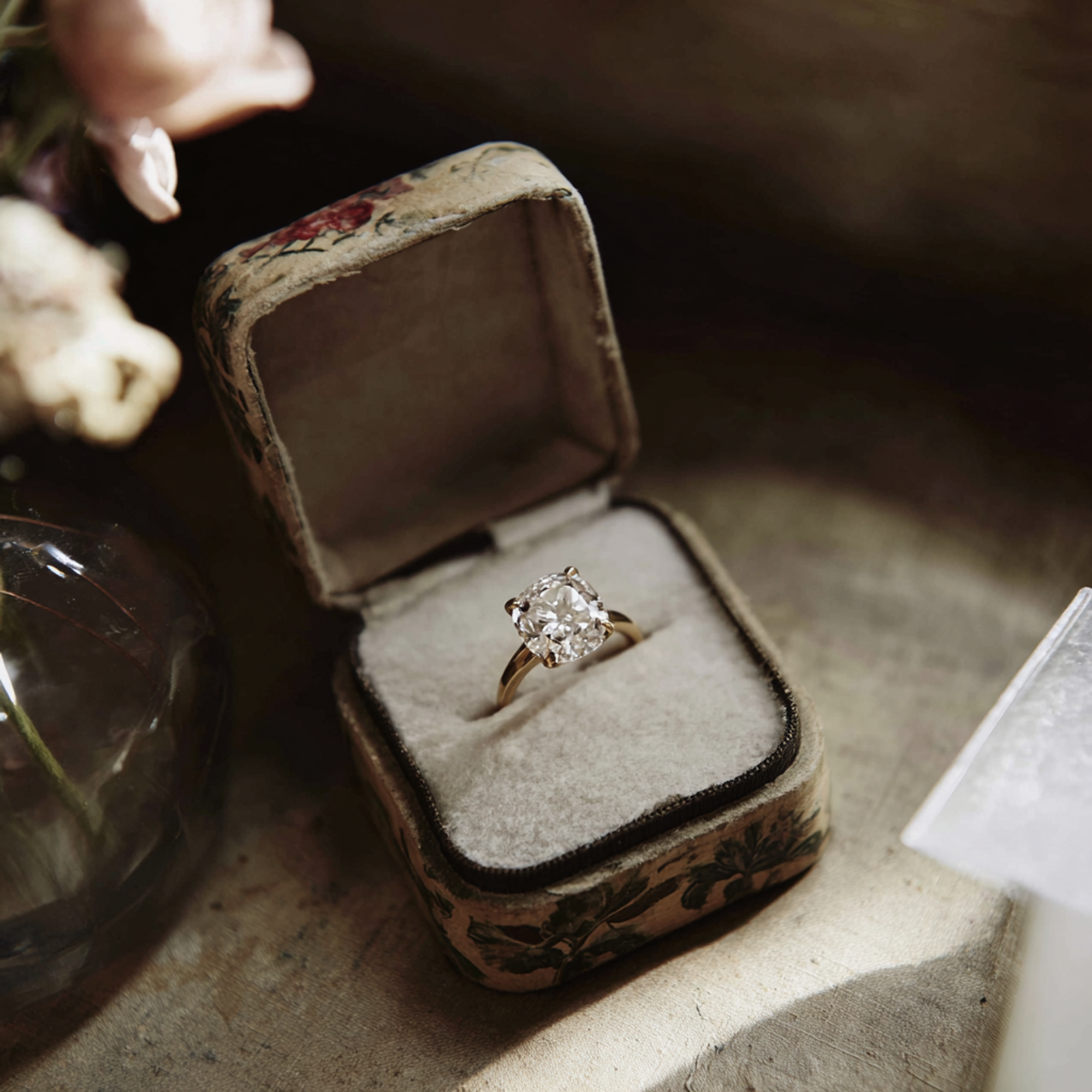
Using a stone that already exists – either from an antique piece of jewellery or reclaimed from an older ring – avoids new mining entirely. Antique and vintage diamonds have a distinct character, often cut using older styles such as old mine or old European cuts. Sourcing a stone this way is widely regarded as one of the lowest-impact choices available (6). A custom jeweller can often set a stone you already own into an entirely new design.
Asking the right questions
No certification can guarantee perfect ethics at every point in a supply chain. A useful approach is to ask your jeweller directly: where does this stone come from? Can you trace it back to its source? What steps does your business take beyond the Kimberley Process? A reputable jeweller should be able to answer these questions honestly.
Lesson glossary
Key terms
- Conflict diamond
- A diamond mined in a war zone and sold to fund armed conflict; also called a blood diamond
- Kimberley Process (KPCS)
- An international certification scheme introduced in 2003 to prevent conflict diamonds from entering the global diamond trade
- Responsible Jewellery Council (RJC)
- An international not-for-profit organisation that sets and audits ethical, social, and environmental standards across the jewellery supply chain
- Lab-grown diamond
- A diamond created in a laboratory with the same physical, chemical, and optical properties as a mined diamond
- Traceability
- The ability to track a stone or material back through every stage of the supply chain to its original source
- Recycled stone
- A gemstone removed from an existing piece of jewellery and reused in a new setting, avoiding the need for new mining
- Supply chain
- The full sequence of steps and organisations involved in getting a product from its raw material to the end buyer