
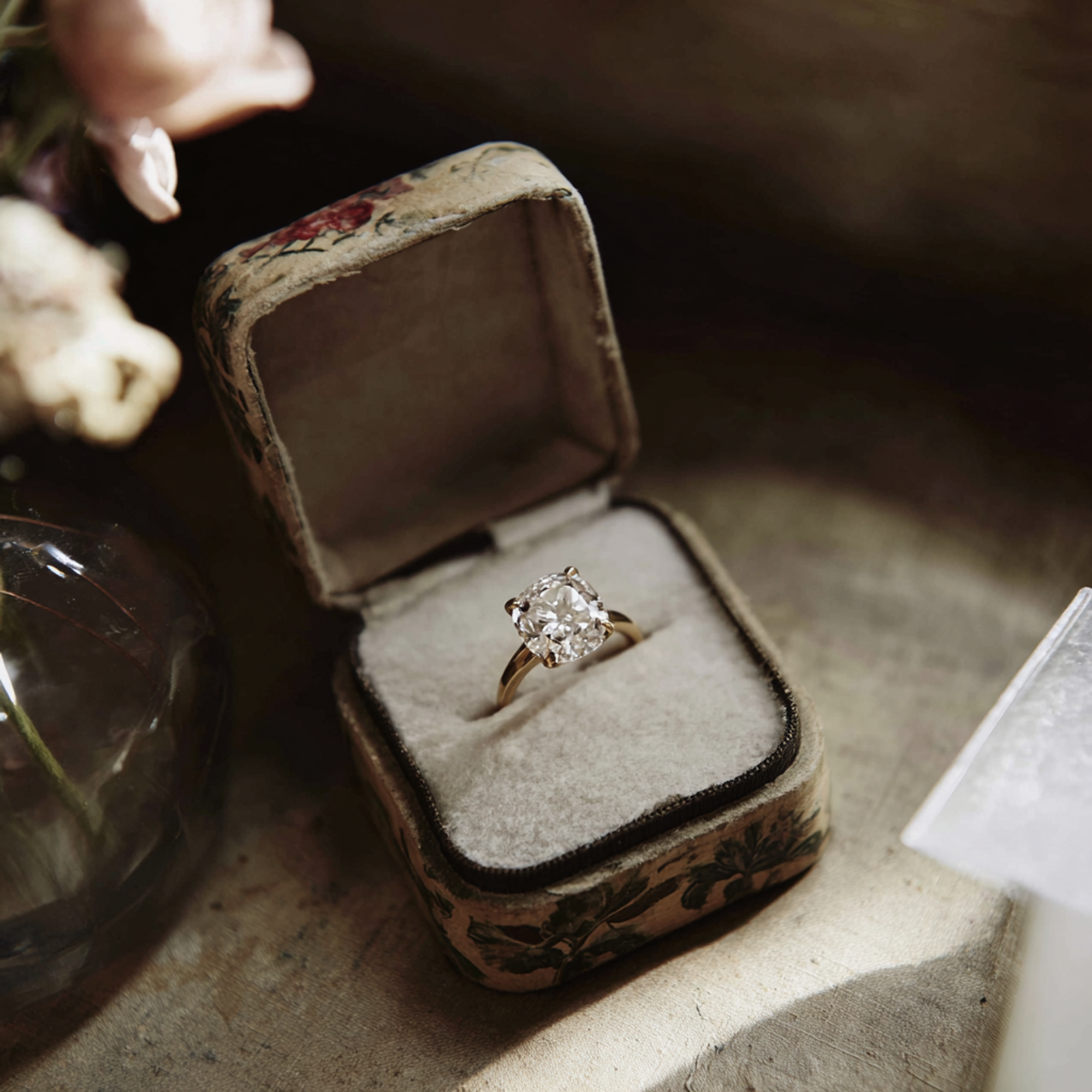
Lesson context
Why this matters
When you start looking at diamonds for an engagement ring, you will quickly come across the term "4Cs." Understanding what each one means helps you have an informed conversation with your jeweller and make choices that suit both your budget and your preferences. The 4Cs give buyers and sellers a shared language so that diamond quality can be described consistently, wherever in the world a stone is sold (1).
Your learning plan
Learning goals
By the end of this lesson, you’ll be able to:
- Name the four Cs and explain what each one measures
- Understand why cut is considered the most important of the four
- Read a basic diamond grading report with confidence
- Recognise how the four qualities interact and affect price
Where the 4Cs come from
Before a shared standard existed, diamond sellers used vague or inconsistent descriptions. In the 1940s, the Gemological Institute of America (GIA) introduced the 4Cs as a universal way of assessing diamond quality (2). The GIA is an independent, not-for-profit organisation and remains the most widely trusted grading authority in the world (1). The 4Cs are now used by jewellers, grading labs, and buyers globally.
Cut
Cut' refers to how well a diamond's facets (its flat, polished faces) are proportioned and arranged. A well-cut diamond reflects light back through its top surface, producing the bright, lively sparkle most people look for (3). A poorly cut stone can look dull, even if its colour and clarity grades are high.
The GIA grades cut in five steps: Excellent, Very Good, Good, Fair, and Poor – but this scale applies only to standard round brilliant-cut diamonds (2). Cut is widely considered the most important of the 4Cs, because it has the greatest impact on how a diamond looks to the naked eye (3).
Colour
Diamond colour is graded on a scale from D (completely colourless) to Z (light yellow or brown) (4). Colourless stones (D–F) are the rarest and most expensive. Many stones in the G–J range appear nearly colourless once set in a ring and offer good value. Colour distinctions between neighbouring grades are often invisible without professional equipment (4).
Clarity
Clarity describes how free a diamond is from internal marks called inclusions and surface marks called blemishes. The GIA clarity scale has eleven grades, from Flawless (FL) at the top to Included (I3) at the bottom (5). Grades are assessed under 10x magnification, meaning that many inclusions are invisible to the naked eye. Stones graded VS1–SI2 often appear perfectly clean when viewed without magnification, making them a practical choice for most buyers (5).
Carat
Carat is a measure of weight, not size. One carat equals 200 milligrams and is divided into 100 points, so a 0.50ct stone may be described as a "fifty-pointer" (2). Larger diamonds are rarer, so price rises sharply with carat weight. However, a heavier stone with a poor cut can look smaller and less impressive than a lighter stone that is cut well (3).
How the 4Cs work together
No single C tells the whole story. Two diamonds of identical carat weight can look and cost very differently depending on their cut, colour, and clarity. When working with a custom jeweller, you can discuss how to balance the four qualities against your budget.
Lesson glossary
Key terms
- 4Cs
- The four qualities used to grade a diamond: cut, colour, clarity, and carat weight
- GIA
- Gemological Institute of America; the independent body that created the 4Cs grading system
- Cut grade
- A score from Excellent to Poor describing how well a diamond's facets are proportioned to reflect light
- Colour scale
- The GIA's D–Z system for grading how colourless or tinted a diamond is
- Inclusion
- A natural internal mark or crystal trapped inside a diamond during its formation
- Blemish
- A surface mark or scratch on the outside of a polished diamond
- Clarity grade
- A score from Flawless to Included (I3) describing how free a diamond is from inclusions and blemishes
- Carat
- A unit of weight for gemstones; one carat equals 200 milligrams
- Facet
- One of the flat, polished faces cut into a diamond's surface to reflect light
- Grading report
- A document from an independent laboratory recording a diamond's 4Cs and other characteristics